
How CDM Can Optimize Nigeria’s Aviation Industry Performance, Safety
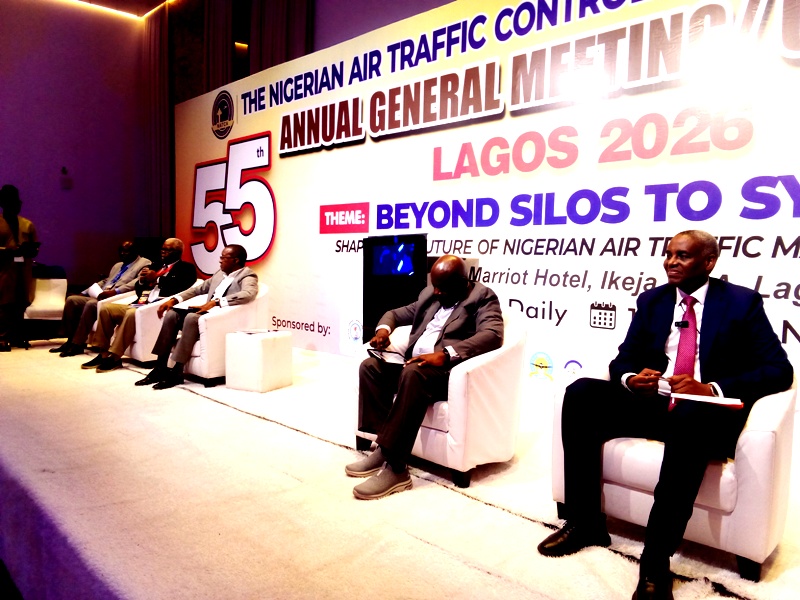
How Collaborative Decision Making (CDM) can optimize overall performance of Nigeria’s aviation industry constituted part of discussions at the panel session of the 55th Annual General Meeting of Nigerian Air Traffic Controllers Association (NATCA) held in Lagos under the theme: “Beyond Silos to Synergy: Shaping the Future of Nigerian Air Traffic Management.”
The President of TopBrass Aviation, Capt. Roland Iyayi said domesitc airlines were willing to offer their input on industry progress and that such collaboration was required. He said government cannot afford the billions of naira required to fix infrastructure deficit in Nigeria’s aviation industry within the next decade and therefore, the available asset should be properly deployed through collaboration.
Iyayi said there exists infrastructure that are hidden in form of situations where some secondary airports operate only as sunset airports, stating that with such policy, whether you have 50 or 10 aircraft, as long as the system restricts your operational capacity, your performance capacity is limited.“
He proposed that paperwork that seems to suffocate capacities should be reviewed.
“We need to see how we can optimize our domestic assets,“ he said.
Managing Director of Aero and former Managing Director, Nigerian Airspace Management Agency (NAMA), Capt. Ado Sanusi said NAMA should be commercialized and have its board inaugurated and that board members should include airlines. He said the board of Nigeria Civil Aviation Authority (NCAA) and other agencies should also be instituted with airlines representatives as members..
According to him, when this happens, they will not merely be competing to please the ministry as was obstained when he was NAMA Managing Director, but would focus on pursuing overall industry objectives.
Former Director General of NCAA, Capt. Shuaibu Nuhu stressed the need for each aviation agency to plug into the overall Key Performance Indicators (KPI).
“They should function in collaborative manner to develop the system,“ he said, adding that the regulatory structure of agencies as provided for by law should be upheld in operations.
He said the NCAA as regulatory body is on top in the structure of agencies but that practically, all aviation agencies are treated the same way. “Some of the agencies even disregard the regulator except directives come from the top,“ he said.
Iyayi blamed this situation for conflicting traffic figures provided by NAMA, NCAA and Federal Airports Authority of Nigeria (FAAN).
“We need to look at this issue wholistically,“ said Iyayi.
Nuhu emphasized that there has to be collation of reports in a centralized system with each sector contributing reports, adding that Safety Management System should basically come from NCAA.
Capt. Prex Porbeni urged stakeholders to make air traffic controllers a central figure in aviation policy decision making process because of their feedback required for effective use of air traffic facilities.
NAMA’s Director of Air Traffic Services, Mr. John Tayo admitted that it is necessary to involve air traffic controllers in the process of equipment acquisition.
He however said CDM was already operating in Nigeria‘s aviation industry except that it had not been institutionalized.
“There are activities that are collaborative decision making activities but are not documented,“ he said, stating that NAMA trained 10 air traffic controllers on CDM in 2025.
Citing an example of CDM on air traffic services operated by Nigeria and Ghana, the keynote speaker at the programme, Mr. Albert Aidoo Taylor said in 1997, Ghana’s air traffic controllers went on strike. The government of Ghana called for air traffic services assistance and Nigeria’s authorities sent air traffic controllers to Accra to provide the services. He called for more of such synergy and collaboration on safety.
Highlighting areas of collaboration between NATCA and other organizations, the President of NATCA, Mr. Amos Edino had said in his welcome speech that “NATCA signed a Memorandum of Understanding with United ATS, Cairo, for the training of ATCOs. In 2025, about 60 controllers were trained in Fatigue Risk Management during our AGM in Abuja. That training contributed to Nigeria’s performance at the ICAO Coordinated Validation Mission in April 2026, at which Nigeria recorded an Effective Implementation score of 91.45 per cent. This year, United ATS will train a further 60 controllers in Air Traffic Flow Management here in Lagos. NATCA is also finalizing Memoranda of Understanding with the Jordan Aviation College, Amman, and ATOM, Dubai.”
“The theme of this meeting is a call to every part of our system: NATCA and NAMA Management, controllers and engineers, the Ministry, the regulator, our sister agencies and the National Assembly. The future of Nigerian air traffic management depends on our working together. We have come a long way, but we still have far to go. Let us continue to build, to engage, and to stand united,” concluded Edino.