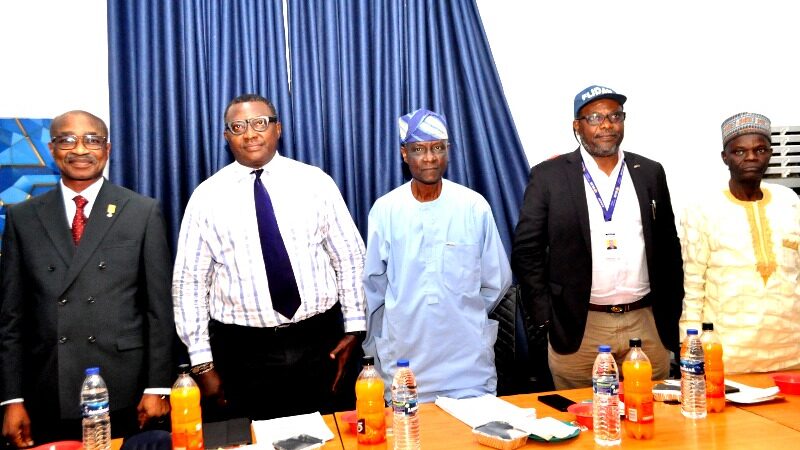
FAAN DCDS Wants Nigeria-UK Cargo Trade Imbalance Fixed

The Director of Cargo Development & Services at Federal Airports Authority of Nigeria (FAAN), Mr. Lekan Thomas has said that the high volume import of cargo by air into Nigeria as against a low export can be addressed, offering measures that can help to do so.
Delivering a keynote speech titled “Improving Export Facilitation Through the Aviation Corridors – A Focus on Nigeria‐UK Trade” on April 23, 2026, Thomas said “every night, cargo aircraft departs from London Heathrow, Amsterdam Schiphol, and Dubai International, full. They arrive in Lagos, Abuja, and Port Harcourt. They offload machinery parts, pharmaceuticals, and consumer goods worth billions. And then, too often, they depart back to Europe, half empty. This is not just an airline problem. It is a Nigerian paradox. We have the demand, the products, and the trade agreements. What we lack is a system that moves Nigerian exports from farm to foreign market with the speed, quality, scale, and reliability that international buyers demand. “
He said “Nigeria is Africa’s largest economy, with a Q3 2025 trade surplus of N6.69 trillion and total exports of N22.8 trillion. Yet in air cargo, we rank fifth on the continent, behind Ethiopia, Kenya, South Africa, and even Ghana. Let that sink in. Ghana, with one‐tenth of our population, has a more efficient air cargo export system.”
Explaining reasons for Nigeria’s status, he said the FAAN Aviacargo Committee, which he heads, conducted extensive domestic and international assessments and came up with findings such as infrastructure deficit in form of critical shortage of cold storage, modern cargo facilities, and fit‐for‐purpose screening equipment and indeed purpose built warehouses; manual processes where clearance takes hours or days whereas in Kenya, it takes approximately 15 minutes; regulatory chaos where approximately 24 separate charges are paid, of which only six are legal; Lack of standardization as billions are lost annually from non‐certified and non‐tracked agricultural produce.
He also identified the gap of siloed agencies as exporters run from desk to desk while their perishable goods lose value by the hour. The sixth gap he calls the missing middle. “The aviation corridor begins long before cargo is loaded onto an aircraft. It begins at the farm gate. Between millions of smallholder farmers and the airport cargo hold lies a gap. Most farmers cannot produce the volume, afford the certification, or manage the documentation that a UK buyer requires. Aggregation centres provide an important answer. These are private‐sector‐owned ecosystems where produce from hundreds or thousands of smallholder farmers is brought together, sorted, graded, tested, processed, packaged, and readied for export. They create volume from fragmented supply and ensure traceability from the individual farm to the final buyer. This cannot be government. FAAN is not a farm aggregator. The solution is Public‐Private Partnership (PPP) – experienced logistics firms, cold chain specialists.”
He said they bring capital to build temperature‐controlled facilities and on‐site laboratories, technical expertise to train farmers in Good Agricultural Practices, post‐harvest handling, moisture management, and aflatoxin control, as well as yield‐enhancing strategies such as improved seedlings and irrigation scheduling. They also bring market intelligence to know exactly what the UK buyer requires (size uniformity, brix levels for fruits, specific moisture content for nuts, permissible residue limits) and they bring “compliance systems to manage phytosanitary documentation, traceability, and certification so that when a consignment arrives at the airport, it is already export‐ready. In Kenya, this model works.”
He said FAAN has embarked on infrastructure transformation to expand, modernize, and equip existing international cargo warehouses in Lagos, Abuja, Kano, and Port Harcourt and has “plans for new cargo villages with dedicated facilities – packaging, testing laboratories, aggregation centres – in Lagos and Abuja. · The moribund domestic cargo terminal at MMIA is now commissioned and operationalized, designed to improve throughput, with similar plans for Abuja, Kano, and Port Harcourt, bearing in mind efficient domestic cargo throuput also feeds international cargo.
Ongoing also is apron expansion and airside upgrades to handle wide‐body freighters (B747, B777F). Exploring PPP models with state governments and private stakeholders. · Discussions on mono‐rail terminations at cargo terminals in Lagos to improve connectivity.
There is also digital transformation, alongside the NSW. “We are developing a cargo community system. Goal: less than 30 minutes processing for known shippers – down from the current hours or days, with plans for PLACI, Pre-loading advanced Cargo Information, to aid trade facilitation further. · Next phase (2026–2028): Target 24/7 or at the least, increased cargo processing hours, at Lagos and Abuja, and automated tracking, and pre‐clearance, as mentioned earlier, with PLACI.”
FAAN is equally attracting dedicated freighter airlines with incentive frameworks like discounted landing and parking charges, volume‐based rebates for cargo airlines. “Active engagement with global carriers and logistics firms. · The absence of sufficient direct freighter connectivity to UK regional hubs (East Midlands, Manchester) is a structural gap to also include, on our roadmap,” he said adding that there is “stakeholder integration, certification, training, and compliance, Service Level Agreements (SLAs) and Standard Operating Procedures (SOPs) across all agencies, working with all statutory agencies on training requirements to function effectively at the airports, CFRRN, NCAA, NCS, with plans for KC3 & RA3 stakeholder Certification and access control into all cargo facilities.
FAAN is doing regulatory harmonization. “The 24 charges (only 6 legal) must become a transparent, predictable schedule – one inspection, one clearance, one cost. The NSW will greatly assist. Hence, we at FAAN are willing converts to its success.”
There is “regional hub development – hub‐and‐spoke model. · Lagos and Abuja as dual cargo hubs and can scale for UK trade. · Feed from secondary airports: Kano, Port Harcourt, Enugu, Jos, Nasarawa, Owerri, Ebonyi, and Ogun State. · Link airports with Special Economic Zones (SEZs) and agro‐processing clusters – enabling true “farm‐to‐flight” corridors.” There are final stage discussions with the State, on the stalled cargo warehouse at Sam Mbakwe International Cargo Airport, Owerri for activation.
He further said “the airport ecosystem presents significant investment opportunities that remain largely untapped. Two specific opportunities come to mind: First: Aggregation centres. The NBCC could facilitate a PPP Aggregation Centre Pilot – in the North West, North Central, South West, and South East. British‐Nigerian joint ventures to design, fund, and operate these centres, with technical assistance from UK agribusiness firms. Second: Farm development and yield strategies. PPP owners should not be passive buyers. They should actively assist farmers with: · Improved seedling distribution · Training in Good Agricultural Practices · Pre‐harvest and post‐harvest extension services · Certification support (organic, Fairtrade, Rainforest Alliance, etc.) The cost of these services is recovered through higher quality exports and premium pricing. The NBCC – with over 400 member organizations and access to 53 British Chambers of Commerce and 71 international affiliates worldwide – is uniquely positioned to catalyze these investments.”
Thomas called on the Nigerian‐British Chamber of Commerce to “establish a working group on air cargo facilitation and aggregation – bringing together exporters, airlines, ground handlers, regulators, logistics providers, and potential aggregation centre investors. Meet quarterly to identify bottlenecks and pilot solutions.
Lean your full weight behind the National Single Window – as detailed earlier. Write the letters. Offer technical assistance. Call out delays. The Chamber has the credibility to do this. Develop a directory of UK importers seeking Nigerian products, with clear specifications – size, moisture content, packaging, certification requirements. Share this with aggregation centres, exporters, and on your website. Facilitate a PPP Aggregation Centre Pilot – identify one or two locations, bring together Nigerian and British partners, and demonstrate the model within 12-18 months.”
He advised Nigerian exporters and aggregators to “invest in quality and traceability. The DCTS is an opportunity; quality and scale are the price of entry. Work with certification bodies, invest in training, and adopt systems that can demonstrate compliance from farm to destination.” He called on regulatory agencies to “continue and adopt the digitization agenda. PLACI, Single‐window systems, electronic documentation, and reduced physical inspections for certified exporters are not luxuries; they are necessities.”
He as well, wants the federal government to “sustain and deepen the policy environment. The 50 per cent freight rate reduction on the Nigeria–East/Southern Africa corridor should be studied for replication on the UK corridor. Tax reforms that reduce the cost of export operations should be prioritized.”
He called on Nigeria’s British partners to “work with us on capacity building – not just in infrastructure, but in aggregation techniques, farm‐level yield strategies, and market access requirements. You have expanded access to your market; helping us meet your standards, is the logical next step.”
In his conclusion, he said “an airport security line with a dozen separate counters – each requiring you to unpack, wait, repack, and move on – is not a security system. It is an obstacle course. For years, Nigerian exports have been running that obstacle course, waiting for cold storage that does not exist, waiting for documentation that takes too long, waiting for a single window that is not yet fully implemented, waiting for aggregation centres that have not been built. We are building them.”