NAMA Asks Legislature To Approve For It, 56% Allocation From Existing 5% Pool

Nigeria Airspace Management Agency (NAMA) today prayed the National Assembly to “approve a 56 per cent allocation to NAMA from the existing five per cent pool, harmonize the affected enactments, recognize obstacle assessment and WGS-84 aeronautical survey as chargeable NAMA technical services, establish transparent, automated remittance and pair the enhanced allocation with firm accountability and oversight.”
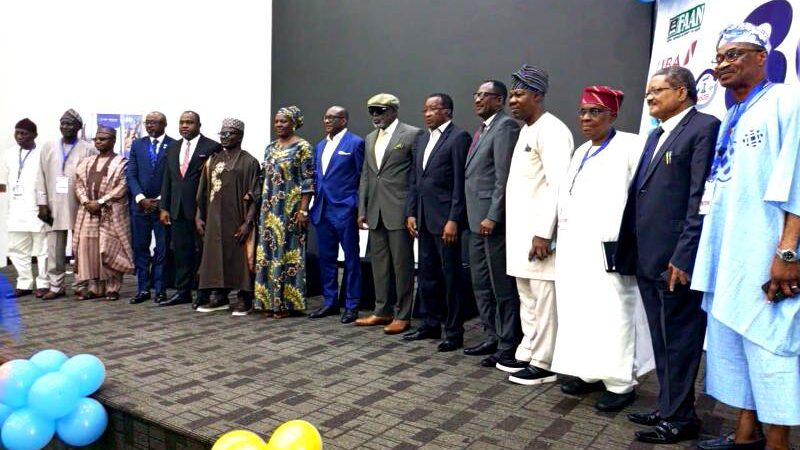
Speaking at a National Assembly Public Hearing on the proposed revision of the statutory sharing formula for the five per cent ticket, charter and cargo sales charge and statutory mandate for obstacle evaluation charges, the Managing Director and Chief Executive Officer of NAMA, Engr. Farouk Ahmed Umar said today, “NAMA receives 22 per cent of the five per cent statutory pool. Let us translate that figure into ordinary terms. On every ₦1,000 of qualifying ticket, charter or cargo sales, the five per cent charge produces ₦50. NAMA receives ₦11 from that ₦50. Our effective share is therefore 1.10 per cent of the underlying sale. If this number is changed to 56 per cent, NAMA would receive ₦28 from the same ₦50. The five per cent charge itself would not increase. The passenger would not be asked to pay a sixth per cent. The amendment would simply direct a fairer share of the existing pool to the infrastructure that guides the aircraft. Why is that necessary? Because the cost of keeping Nigerian airspace safe has outgrown a formula that does not adequately reflect NAMA’s statutory burden.
Publicly reported figures for 2023 showed approximately ₦21 billion in personnel expenditure, more than ₦12 billion in capital expenditure and more than ₦10 billion in overheads, a total cost profile exceeding ₦43 billion. These are not abstract numbers. Behind them are controllers, engineers, communication systems, navigation aids, surveillance platforms, power systems, spares, software, calibration, training and facilities spread across our country.
At the same time, a navigation charge as low as ₦11,000 per flight had remained unchanged since June 2008. Consider what has happened to the cost of fuel, electricity, foreign exchange, imported components, software licences and specialist training since 2008. The service has had to absorb today’s costs with yesterday’s tariff base. The dedication of our workforce has helped bridge that gap, but dedication is not a substitute for a sustainable funding system.
Our surveillance infrastructure also illustrates the urgency. The Total Radar Coverage of Nigeria system has served the country over many years. Its sites and components now require a deliberate renewal and transition programme. As equipment ages, spare parts become harder to obtain, and manufacturer support changes. Responsible management does not wait for obsolescence to become failure. It plans replacement, builds redundancy, trains the people who will operate the new system and keeps the old and new services safely coordinated during transition. In the same vein, NCAA regulates and issues Aviation Height Clearance Certificate and applicants pay fees for that certification. Yet the aeronautical question is operational: will a proposed mast, tower, crane or high-rise building interfere with a flight procedure, minimum altitude, navigation aid, surveillance system or protected airspace? NAMA performs this safety-critical technical work but receives no dedicated payment for the service. NAMA has a department that conducts survey and obstacle assessment and maintains specialized in-house capability in WGS-84 aerodrome and obstacle surveying. Through the WGS-84 and performance-based navigation services across all Nigerian airports, the Agency developed aviation survey expertise, digital equipment and GIS capability.
As Nigeria’s sole Air Navigation Service Provider, NAMA is the only federal aviation agency that connects WGS-84 survey data, obstacle analysis, aeronautical information, procedure design and the operational management of airspace in one technical chain. NAMA therefore asks for a fair and transparent arrangement. NCAA should retain the regulatory component of the Aviation Height Clearance. NAMA should be paid obstacle registration, identified technical-services component for WGS-84 survey validation, obstacle assessment, procedure-impact analysis and field work and such fee should be remitted directly to NAMA.
In accordance with ICAO’s cost-recovery model, the revenue is to maintain the equipment, data, software and trained professionals that make the clearance technically meaningful. We are therefore recommending a sharing formula of 90% to 10% in favour of NAMA.”
Umar further said “safety is not purchased once. It is preserved through a cycle: procure, install, test, train, operate, maintain, calibrate, secure, renew. If any part of that cycle is chronically underfunded, the weakness accumulates quietly. The system may continue to function because professionals improvise and procedural safeguards are applied, but the margin of resilience becomes thinner. Parliament has the opportunity to act before that margin is tested. The global aviation system is also changing. Air navigation is becoming more digital, more interconnected and more exposed to cyber risk.
Performance-based navigation, digital aeronautical information, satellite-enabled surveillance and integrated flight data systems promise better capacity and efficiency, but they require investment, data quality, new skills and strong cyber defences. Nigeria should not merely maintain the airspace of yesterday; it must build the airspace that tomorrow’s traffic will require. A properly funded NAMA produces benefits far beyond the Agency.
Reliable communication and surveillance permit efficient separation. Modern procedures can shorten routes and approaches. Better availability reduces disruption. Stronger systems support airlines, airports, passengers, trade, tourism and national security coordination. An aircraft that moves safely and efficiently through Nigerian airspace is an economic activity enabled by invisible infrastructure. NAMA is not asking the National Assembly for a blank cheque. NAMA supports accountability equal to the responsibility we seek. It supports automated collection and remittance, quarterly disclosure of receipts and projects, annual independent audit, transparent procurement and measurable performance indicators. We are prepared to report what was received, what it purchased, which milestone was achieved and what improvement the user obtained.
NAMA also asks that the statutes be harmonized. The Civil Aviation Act presently states 22 per cent for NAMA, while the NAMA Act refers to 23 per cent in its Fund provisions. The law should speak with one voice. The beneficiaries should be named correctly; the percentages should total 100 per cent; collection and remittance responsibilities should be unambiguous; and the effective date should be clear. NAMA recognizes that a reallocation raises legitimate concerns for other agencies. Those concerns deserve evidence-based consideration. Our position is that the solution should be built around audited cost, mandate and risk, not around the preservation of historical percentages for their own sake.
A regulator and an Air Navigation Service Provider are both indispensable, but their cost structures are not identical. The law should recognize those differences while ensuring that every safety institution remains viable.”
According to Umar, “when a pilot calls an air traffic controller over Nigerian airspace, that voice is more than a radio transmission. It is the sound of a national safety system working. Behind it are years of training, towers and centres, antennas and links, radar and navigation aids, engineers and procedures, generators and batteries, software and vigilance. The country expects that voice to be clear, confident and continuously available.
The amendment before you is therefore not merely about dividing revenue. It is about deciding whether the institution entrusted with guiding aircraft will have the stable resources to maintain today’s services and renew tomorrow’s infrastructure. It is about whether we finance safety reactively, after systems become critical, or responsibly, through planned maintenance and replacement.
Before I conclude I want us to ponder over this: what is the practical value of even the most rigorous regulation if the Air Navigation Service Provider lacks the functional systems, trained personnel and resilient infrastructure required to translate that regulation into the safe movement of aircraft?”