
Benin Airport: NSIB Wants FAAN To Provide Suitable Control Tower Location For NAMA
“The Federal Airports Authority of Nigeria (FAAN) should provide a suitable control tower location for the Nigerian Airspace Management Agency (NAMA) to ensure unrestricted view of all the movement areas of the aerodrome.”
This is a safety recommendation of the Nigerian Safety Investigation Bureau (NSIB) in its preliminary report on its ongoing investigation into the accident involving an Embraer ERJ 170-100LR aircraft with nationality and registration marks 5N-ENR, operated by Enugu Air Limited.
NSIB further recommended that “the Nigeria Civil Aviation Authority (NCAA) should ensure that the Federal Airports Authority of Nigeria (FAAN) remove the fixed structures of the decommissioned localizer installation located at the end of Runway 05 at Oba Akenzua II Airport, Benin” and “the Nigeria Civil Aviation Authority (NCAA) should ensure that the Control Tower is positioned to provide unrestricted view of all the movement areas of the aerodrome.”
Also, “the Nigerian Meteorological Agency (NiMet) should restore and maintain the serviceability of the weather information display equipment provided for operational use at Oba Akenzua II Airport, Benin control tower, and ensure that current meteorological information is reliably available to Air Traffic Services for timely dissemination to flight.
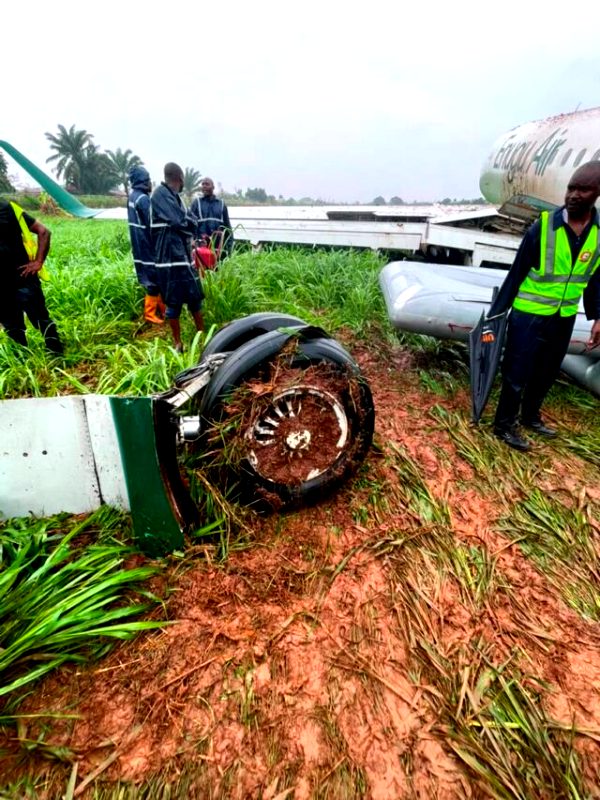
The accident occurred on July 23, 2026 at about 14:55 h during a scheduled passenger flight ENU4264 from Murtala Muhammed International Airport, Lagos, to Oba Akenzua II Airport, Benin, Edo State. The aircraft, which had five crew members and 63 passengers on board, landed on Runway 05 at Oba Akenzua II Airport and subsequently overran the end of the runway, entering the unpaved area beyond the runway. The aircraft struck approach-lighting installations and two fixed concrete structures associated with a decommissioned localizer installation. All 68 occupants were evacuated without injury using the emergency escape slide.
According to the report, further findings indicate that the flight crew were licensed and qualified to conduct the flight. The aircraft had a valid Certificate of Airworthiness. The First Officer was the Pilot Flying and the Captain was the Pilot Monitoring. The take-off, climb, cruise and descent phases of the flight were normal. The aircraft overran the end of Runway 05. 6. All occupants evacuated without injury, and there was no post-impact fire. Weather deteriorated during the aircraft’s arrival, with moderate rain and reduced visibility reported before landing. ATC advised the crew that the approach path to Runway 23 appeared better than the approach path to Runway 05; the crew acknowledged and continued the RNAV approach to Runway 05. ATC, while issuing the landing clearance, also advised the crew that the runway surface was wet. The ATC communication given during the landing clearance to the crew did not include Runway Condition Report/Runway Condition Code (RCR/RWYCC). During the approach briefing, the crew stated that the autobrake system was not working and that manual braking would be used for landing. FDR data recorded a tailwind component during the final approach and landing.
The aircraft crossed the Runway 05 threshold at a recorded radio altitude of about 93.5 ft. The aircraft landed at about 1,641.5 m from the threshold of Runway 05. Preliminary Report 5N-ENR 31 FDR information showed that increased brake pressure and ground-spoiler activation were recorded following touchdown. Post-occurrence examination of the wreckage found the thrust-reverser assemblies in a deployed condition..The aircraft struck the approach-lighting installations and impacted two fixed concrete structures of a decommissioned localizer installation, located beyond the runway end. The aircraft impacted the concrete structure, the landing-gear assemblies broke and separated from the aircraft. Field evidence indicated that the nose landing gear separated first, followed by the right main landing gear and then the left main landing gear. The weather information display equipment provided for operational use at Benin tower was unserviceable at the time of the occurrence. An uncompleted building structure is obstru cting the controller’s line of sight towards the end of Runway 05 (Runway 23 threshold end).
The preliminary report presents the factual information gathered so far, including information from witness statements, flight recorders, air traffic control communications and a preliminary inspection of the aircraft. The investigation remains ongoing, and further technical examinations are underway.
The report is available for download on the NSIBwebsite for members of the public and the media. As part of its commitment to public transparency and the communication of safety information, the NSIB has also released a preliminary flight path recreation video based on data available at this stage of the investigation. The flight path recreation video is available here
In accordance with Annex 13 to the Convention on International Civil Aviation, the sole objective of the investigation is the prevention of accidents and incidents. It is not the purpose of the investigation to apportion blame or liability.
According to Mrs. Funke Adebayo-Arowojobe, NSIB Director, Public Affairs and Family Assistance, “the information contained in the preliminary report is subject to further review and analysis, and its content may still change. The final report will present the Bureau’s conclusions and any further safety recommendations arising from the completed investigation.”