
Ibom Air Expands Fleet With A220-300 As Passenger Threshold Nears Five Million
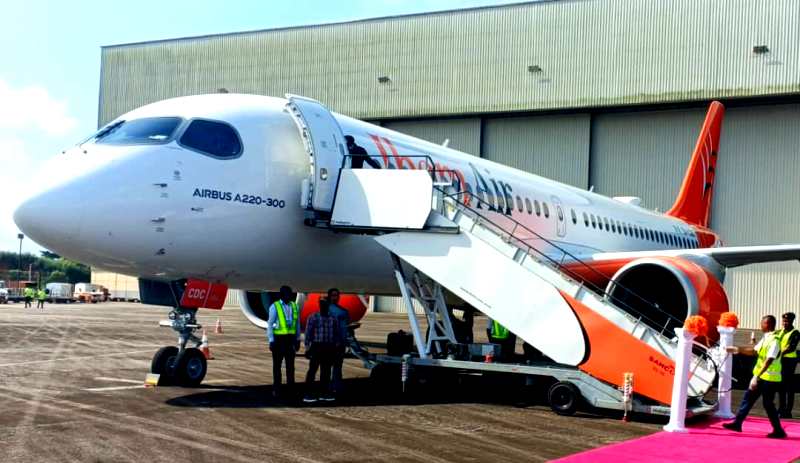
Ibom Air has received a brand-new Airbus A220-300 as it taxied through the traditional arch of a water cannon salute at Victor Attah International Airport in Uyo, marking the arrival of the third ultra-modern jet delivered directly from the Airbus assembly facility in Mirabel, Canada.
The touchdown of the fuel-efficient twin-engine jet brings Ibom Air’s active fleet to 10 aircraft—comprising 7 Bombardier CRJ-900s and 3 Airbus A220-300s—and serves as the catalyst for an airline rapidly approaching 5 million cumulative passengers by the end of September 2026.
Beyond the expanded seating capacity, the official reception underscored how multi-administration policy continuity, targeted infrastructure investments, and local workforce development are transforming Akwa Ibom State into an aviation hub for West and Central Africa.
Addressing guests at the tarmac reception, Akwa Ibom State Governor Pastor Umo Eno outlined the operational metrics underpinning the state-owned carrier’s expansion strategy.
“With 4,953,512 passengers safely carried across 65,152 scheduled flights to date, Ibom Air is on track to cross the 5 million passenger landmark before the end of this month,” Governor Eno stated. “Out of our current 10 aircraft, five were acquired under this administration to ensure our route network keeps pace with regional demand.”
The governor disclosed that the airline, which currently services seven domestic destinations and one regional route (Accra, Ghana), is preparing to expand its network to 12 destinations and 15 routes by 2027. This roadmap includes a new domestic connection alongside regional services to Douala (Cameroon), Libreville (Gabon), and Malabo (Equatorial Guinea).
Ibom Air Chairman Mfon Udom explained that the addition of the A220-300 directly enables the carrier to restore its full domestic flight schedule while building out its intra-African network.
“The arrival of this aircraft allows us to immediately return to our core domestic frequencies—restoring three daily flights on the Uyo–Lagos and Uyo–Abuja routes, and ramping Lagos–Abuja back up to seven daily frequencies,” Udom noted. “Phase one of our regional expansion will connect Uyo directly to Douala, Libreville, and Malabo. As we receive the remaining aircraft from our 10-unit order via direct purchases and lease-purchase arrangements, our reach will extend across the continent.”
The carrier’s footprint extends significantly into the local economy. Operational data reveals that over ₦60 billion has been injected directly into the Akwa Ibom economy through Ibom Air’s commercial activities.
The airline employs 753 full-time direct staff, with Akwa Ibom indigenes accounting for 64% (478 employees) of the workforce, alongside an estimated 2,000 indirect jobs sustained state-wide.
Governor Eno highlighted that technical human capital remains central to the state’s long-term aviation vision, tying the aircraft’s delivery to celebrations marking Akwa Ibom’s 39th anniversary.
“Infrastructure is only as effective as the professionals who manage it,” Eno said, acknowledging Aviation Minister Festus Keyamo and the Federal Government for granting the terminal international airport status. “Out of the 30 pilots currently flying with Ibom Air, 14 are Akwa Ibom indigenes. Furthermore, 16 of our 40 aircraft engineers are local talent. We currently have 10 additional pilots in simulator training in Addis Ababa and 10 aviation specialists at NCAT Zaria.”
There is an integrated “Aerotropolis” Vision. Framing the delivery within the state’s broader economic architecture, Uwem Ekanem, Special Adviser on Aviation and Airport Development, emphasized that the airline operates as part of a three-part ecosystem alongside the state’s commercial Maintenance, Repair, and Overhaul (MRO) facility and the upgraded international terminal.
“We are building an Aerotropolis—a city within a city designed to generate foreign exchange, drive tourism, expand air cargo operations, and develop high-skilled technical personnel,” Ekanem said.
Ekanem also addressed market access at the airport, clarifying that Victor Attah International Airport remains open to all commercial operators:
“Allegations of a monopoly are completely unfounded. As an airport authority, our goal is to maximize service options for travelers. Air Peace is scheduled to commence operations here in September, and discussions are ongoing with ValuJet.”
Tracing the airport’s origins, Senator Emmanuel Ibok Essien, former Senate Deputy Chief Whip and founder of Rittman University, attributed Akwa Ibom’s aviation growth to rare political alignment across successive state leaderships.
“In 1999, Governor Victor Attah, Senator Udoma, and I traveled to Houston where the concept for this airport was born,” Sen. Essien recalled. “Despite early resistance at the national level, we persisted. In Nigeria, policy disruptions often accompany leadership changes. In Akwa Ibom, each governor has built directly upon his predecessor’s foundation: Victor Attah laid the groundwork, Godswill Akpabio landed the first plane, Udom Emmanuel launched Ibom Air, and Governor Umo Eno has completed the international terminal and expanded the fleet.”
Welcoming the flight crew comprising Capt. Tijani Shaddad, Senior First Officer Akaninyene Bassey, and Senior First Officer Idongesit Okono—Ibom Air’s Chief Pilot, Ruth Adebanwo, added that the A220-300’s reduced noise footprint, lower carbon emissions, and fuel efficiency provide the ideal operational balance required for the airline’s next phase of growth.